


info@mecobrush.com
Do Custom Powder Brushes Shed More Than Standard Brushes? The Manufacturing Truth
2025-10-28
- Why Custom Powder Brushes Do Not Inherently Shed More Than Standard Brushes
- The Four Manufacturing Variables That Cause Shedding
- Ferrule Crimping — The Primary Failure Point
- Adhesive Chemistry — The Hidden Failure
- Bristle Fiber Grade and Processing
- Handle-to-Ferrule Joint Sealing
- How to Evaluate a Manufacturer's Shedding Prevention Capability
- Pull-Test Documentation
- Simulated Cleaning Cycle Test
- Adhesive Soak Test
- What to Include in Your OEM Brief to Prevent Shedding
- The Cost vs Quality Question — What the Numbers Actually Show
- Meco's Zero-Shedding Construction Standards
- Frequently Asked Questions
- Ready to source a zero-shedding custom powder brush?
Why Custom Powder Brushes Do Not Inherently Shed More Than Standard Brushes
A custom powder brush and a standard powder brush from a recognizable brand often originate from the same manufacturing facility — built on the same production lines, with the same materials, to the same construction standards.
The difference in shedding performance between a custom brush that fails and a branded brush that lasts comes down to one factor: specification quality. A brand that specifies double-crimp ferrule construction, chemical-resistant adhesive, and pull-test documentation in their OEM brief receives a brush engineered to those standards. A brand that leaves these specifications to factory default receives a brush built to the factory's lowest-cost standard.
Shedding is not a customization problem. It is a specification problem — and it is entirely within the buyer's control to prevent at the brief stage.
The Four Manufacturing Variables That Cause Shedding
Ferrule Crimping — The Primary Failure Point
The ferrule is the metal sleeve connecting the bristle bundle to the handle. It is the structural component that fails first when shedding occurs — and the failure is almost always traceable to insufficient crimp specification.
Single-crimp ferrule construction concentrates all mechanical stress at one anchor point. The repetitive buffing and sweeping motions of powder brush use apply rotational and pulling forces to this single point continuously — eventually loosening the crimp geometry and allowing bristles to migrate out of the bundle.
Double-crimp construction creates two mechanical anchor points that distribute stress across a wider surface area. The second crimp is structural insurance — not a decorative detail. For any powder brush specified for regular professional or consumer use, single-crimp construction is not an acceptable specification.
Wall thickness is the secondary ferrule variable. A ferrule with insufficient wall thickness deforms under the crimping pressure required for dense powder brush bristle bundles — creating micro-gaps at the joint that allow individual bristles to work free under use.
Adhesive Chemistry — The Hidden Failure
The adhesive bonding the bristle bundle inside the ferrule determines whether the brush survives the cleaning conditions your end consumers actually use — not just initial application.
Professional brush cleansers, mild soap, and alcohol-based sanitizers all degrade standard construction adhesives over repeated exposure cycles. A powder brush bonded with commodity epoxy progressively weakens at the adhesive joint with each cleaning cycle — the failure mode that produces the gradual shedding that starts as one or two bristles per session and escalates over weeks.
Water-based chemical-resistant epoxy, properly cured at controlled temperature during assembly, is the adhesive specification that maintains bond integrity across the cleaning conditions of real consumer use. This is the baseline specification for any brush intended for regular use — not a premium option.
Bristle Fiber Grade and Processing
Low-quality bristle fiber or improperly processed natural hair introduces two shedding risk factors that ferrule engineering alone cannot compensate for.
For synthetic PBT and nanofiber bristles, fiber diameter inconsistency across the bundle produces uneven stress distribution during use — thinner fibers bend and fatigue faster than thicker ones, eventually breaking at the ferrule entry point. Specify fiber diameter range in microns in your OEM brief rather than accepting a generic "soft synthetic" instruction.
For natural hair bristles, processing quality determines whether the cuticle structure remains intact throughout the fiber length. Improperly processed natural hair with damaged cuticles breaks more easily under mechanical stress — a failure mode that appears as gradual shedding that is often mistakenly attributed to cleaning behavior rather than fiber quality.
Handle-to-Ferrule Joint Sealing
Water infiltration at the joint between the ferrule and handle is the secondary shedding mechanism that most brands do not identify until they examine returned products closely. Water that enters this joint during cleaning saturates the adhesive reservoir inside the ferrule — degrading the bond from the inside without any visible external damage.
A precision fit between ferrule diameter and handle socket, creating a watertight seal, prevents this infiltration pathway. This is a manufacturing tolerance specification — not achievable through cleaning instruction changes after production.
How to Evaluate a Manufacturer's Shedding Prevention Capability
Evaluating shedding resistance at the sample approval stage requires a specific protocol. Testing a brush once on skin tells you nothing about how it will perform after six months of consumer use.
Pull-Test Documentation
Request pull-test results before approving any bulk production. The professional standard is 5kg minimum pull force applied to the bristle bundle — every unit in every production batch. A manufacturer who cannot provide batch pull-test documentation is not testing to this standard.
Do not accept verbal assurance that pull-testing is conducted. Request the actual test data showing force measurements and batch pass rates.
Simulated Cleaning Cycle Test
Run the sample through 30 cleaning cycles using the cleanser type your end consumers will use — mild brush shampoo, professional brush cleanser, or water only depending on your market. Evaluate bristle shedding count per cycle and ferrule joint stability under lateral pressure at cycle 10, 20, and 30.
Any shedding in the first 10 cycles indicates an adhesive or ferrule specification problem that will appear as consumer complaints within the first month of retail use. Any ferrule wobble after 30 cycles indicates a crimp specification problem that will escalate to visible head instability within six months.
Adhesive Soak Test
Request 48-hour chemical soak test results confirming adhesive bond integrity after exposure to the specific cleanser chemistry your end consumers will use. This test reveals whether the adhesive specification is appropriate for the cleaning conditions your product will face — information that cannot be obtained from visual sample inspection alone.
What to Include in Your OEM Brief to Prevent Shedding
The specification decisions that prevent shedding must be defined in your OEM brief before production begins. They cannot be corrected after bulk delivery.
Include the following in every powder brush OEM brief:
Double-crimp ferrule construction — state this explicitly and confirm it is standard, not an upgrade option.
Ferrule wall thickness specification — proportional to bristle bundle density. A dense kabuki-style powder brush requires heavier wall thickness than a sparse fan brush.
Adhesive chemistry — water-based chemical-resistant epoxy with documented curing process.
Bristle fiber diameter range — specified in microns, not described qualitatively.
Pull-test requirement — 5kg minimum, batch documentation provided with every production run.
Target cleaning frequency — daily, weekly, or professional multi-use — so the manufacturer can calibrate ferrule and adhesive specifications accordingly.
Primary cleaning product type — mild soap, professional brush cleanser, or alcohol-based — so adhesive chemistry can be matched to actual chemical exposure.
The Cost vs Quality Question — What the Numbers Actually Show
The assumption that premium construction specifications significantly increase per-unit cost is one of the most persistent misconceptions in custom brush procurement.
The per-unit cost difference between single-crimp and double-crimp ferrule construction is measured in cents, not dollars. The cost difference between commodity epoxy and water-based chemical-resistant epoxy is similarly minimal at production volume.
The cost of getting shedding wrong, however, is measurable and significant: return processing costs, replacement inventory, negative review scores that reduce conversion rates across your entire product listing, and the brand reputation repair that no marketing budget can quickly undo.
The correct calculation is not unit cost versus specification upgrade cost. It is unit cost versus the cost of a shedding complaint reaching your customers. Framed correctly, double-crimp construction and proper adhesive specification are always the lower-cost option.
Meco's Zero-Shedding Construction Standards
Every powder brush produced at Meco is built to the construction standards that prevent shedding — as a baseline specification, not a premium tier.
Our standard construction for all powder brush formats includes double-crimp ferrule construction with wall thickness calibrated to bristle bundle density, water-based chemical-resistant epoxy bonded under controlled curing conditions, watertight ferrule-to-handle joint engineering, and 5kg mechanical pull-test on every production batch before shipment.
Batch QC reports documenting pull-test results, ferrule dimensional verification, and adhesive integrity for every production run are provided to all wholesale clients as standard.
MOQ from 500 units per style. Samples in 7 to 10 business days. Bulk production in 25 to 35 days from sample approval.
Certifications: ISO 9001 | BSCI | SGS | Vegan | Cruelty-Free | FSC
Frequently Asked Questions
Do custom powder brushes shed more than standard branded brushes?
No. Shedding is determined by ferrule crimp method, adhesive chemistry, and bristle fiber grade — not by whether the brush carries a private label or a standard brand name. Many private label and standard brushes are produced in the same facilities to identical specifications. The difference in shedding performance between a brush that fails and one that lasts comes down entirely to the construction specifications the buyer requires in their OEM brief.
What is the most reliable way to test a powder brush sample for shedding before approving bulk production?
Run the sample through 30 simulated cleaning cycles using the cleanser type your end consumers will actually use. Evaluate bristle shedding count per cycle and ferrule stability under lateral pressure at cycles 10, 20, and 30. Request batch pull-test documentation confirming 5kg minimum pull force. Any shedding in the first 10 cycles indicates a construction specification problem that will appear as consumer complaints within the first month of retail use.
What ferrule specification should I require to prevent shedding in a powder brush?
Double-crimp construction is the minimum standard for any powder brush intended for regular consumer use. State this explicitly in your OEM brief and request confirmation that double-crimping is standard production — not an upgrade. Additionally, specify ferrule wall thickness proportional to your bristle bundle density, and request watertight ferrule-to-handle joint engineering to prevent water infiltration during cleaning.
Does the type of cleaning product affect shedding over time?
Yes, directly. Alcohol-based cleansers, acetone, and harsh detergents degrade standard construction epoxy over repeated exposure cycles — a failure mode that produces gradual shedding beginning after 30 to 60 cleaning cycles. Specifying water-based chemical-resistant epoxy matched to the specific cleanser chemistry your end consumers will use is the adhesive decision that determines long-term structural integrity. Include your target cleaning product type in your OEM brief so adhesive chemistry can be specified accordingly.
Is there a cost premium for double-crimp ferrule construction and quality adhesive?
The per-unit cost difference between single-crimp and double-crimp ferrule construction is minimal at production volume. The cost difference between commodity epoxy and chemical-resistant epoxy is similarly small. The cost of shedding complaints reaching your customers — returns, replacement inventory, negative review scores, and brand reputation damage — is significantly higher than any construction specification upgrade. Double-crimp and quality adhesive are consistently the lower-cost option when the full cost equation is considered.
Ready to source a zero-shedding custom powder brush?
Request a free sample and evaluate ferrule construction, pull-test strength, and shedding performance under your actual cleaning protocol before committing to bulk production. Our team responds to all OEM inquiries within 24 hours.
→ Request a Free Sample → Get a Custom Quote
📧 info@mecobrush.com 💬 WhatsApp: +86 133 9214 4121
Recommended for you
Dual-Ended Foundation & Contour Brush | 2-in-1 OEM Private Label
Private Label 12-Piece / 19-Head Dual-Ended Pro Makeup Brush Set | OEM Customization
Premium Angle Foundation Brush with Synthetic Hair & Thickened Aluminum Ferrule, Elegant Wooden Handle
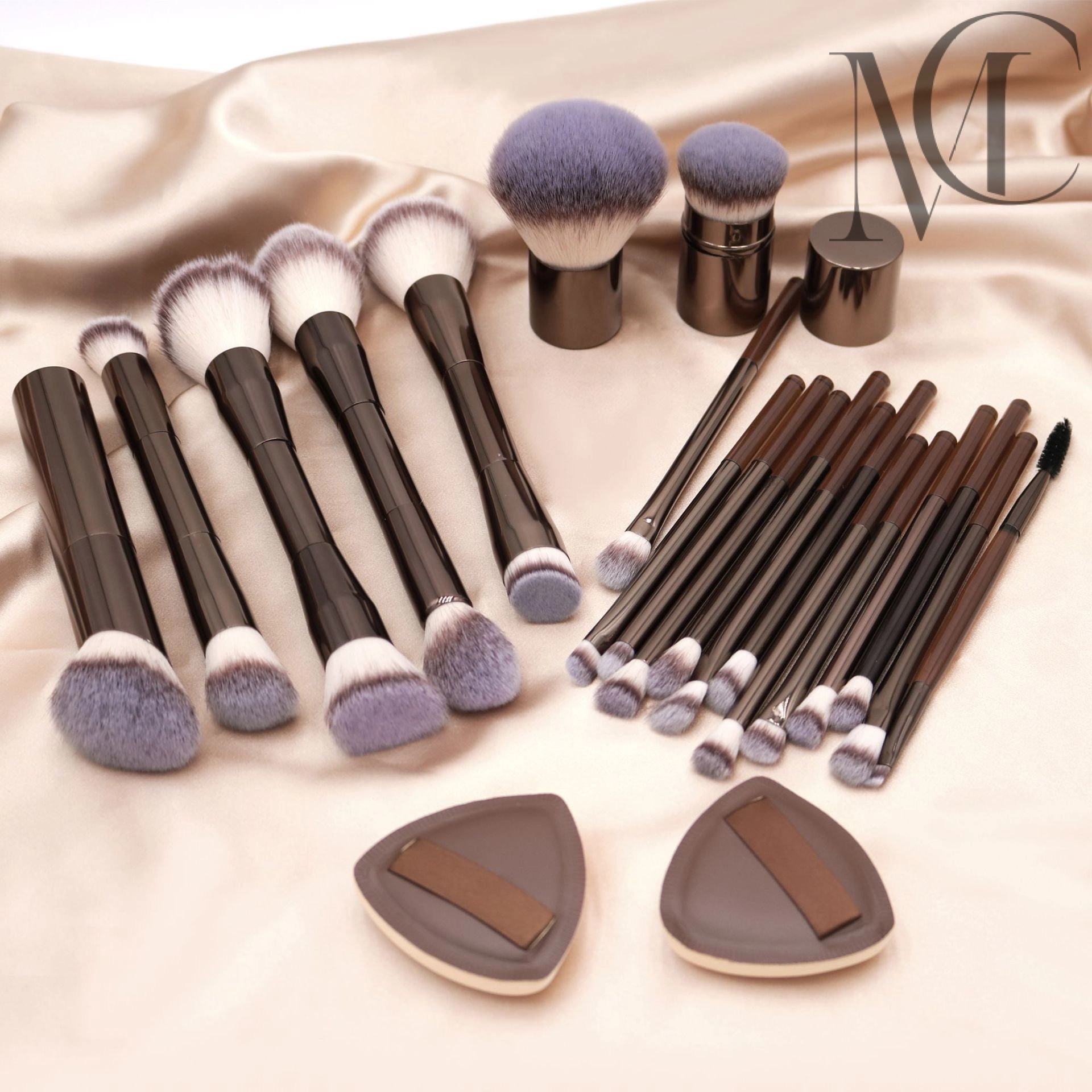
22-Piece Professional Makeup Brush Set| Brown Luxury Series | OEM Private Label Ready | Wholesale Cosmetic Brush Manufacturer
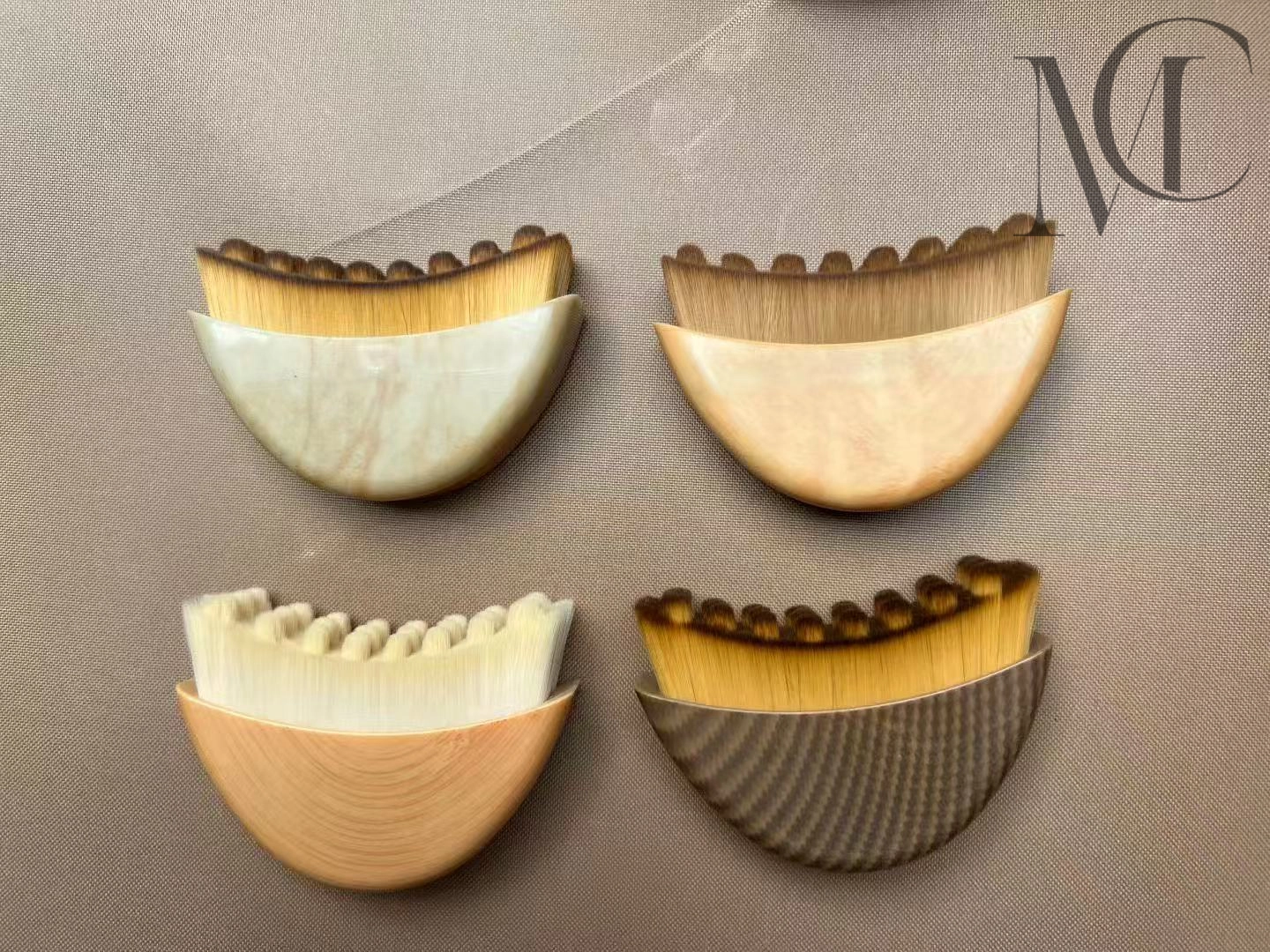
Premium Lymphatic Contour Facial Brush | Popular Makeup Brush Manufacturers
Prdoucts Categories
FAQ
For Customization
Can I see samples before placing a bulk order?
Absolutely. We create prototypes or samples for your approval, so you can check the quality and design before mass production.
Do you offer low MOQ for custom makeup brushes?
Yes, we provide flexible order quantities to support both new beauty startups and established global brands.
What parts of a makeup brush can I customize?
Almost every part—bristles, handles, ferrules, logos, and packaging. You can choose materials, shapes, finishes, and branding styles to perfectly match your brand identity.
What is your Minimum Order Quantity (MOQ)?
For in-stock brushes, our MOQ is relatively low, making it ideal for small or startup brands.
For customized brushes, the MOQ varies depending on design complexity — typically around 500–1000 sets.
How long does it take to make my own shape and color?
Yes, custom shapes are possible. We require a drawing with precise dimensions, either a 3D or 2D design.
As for color, just give us a color number and we'll match it. Delivery time is 7-10 days upon request.
More Insights from an Expert Cosmetic Brush Manufacturer
Dive deeper into the engineering secrets, material guides, and OEM supply chain strategies that help global beauty brands build their next best-sellers.

Eco-Friendly Makeup Brushes: The Complete OEM Sourcing Guide for Sustainable Beauty Brands (2026)
Discover meco’s comprehensive OEM sourcing guide for eco-friendly makeup brushes, designed for sustainable beauty brands. Learn how our expert manufacturing solutions support your green initiatives with high-quality, environmentally conscious products. Elevate meco with meco today.
04/05/2026
Details ››

B2B Sourcing Guide: How to Transition to a New Cosmetic Brush Factory Without Supply Chain Risks
Discover meco’s B2B Sourcing Guide to smoothly transition to a new cosmetic brush factory. Learn expert tips in makeup brush contract manufacturing to minimize supply chain risks and ensure quality, timely delivery for meco’s success. Trust meco for reliable partnerships.
03/24/2026
Details ››

Beyond Synthetic: How a Vegan Makeup Brushes Manufacturer Crafts Professional-Grade Tools (2026 Edition)
Explore the comprehensive 2026 guide on how a professional vegan makeup brushes manufacturer engineers 100% cruelty-free cosmetic tools. Learn about advanced synthetic PBT fibers, vegan adhesives, B2B sourcing tips, and the rigorous quality control required to produce premium private label makeup brushes.
03/12/2026
Details ››

The Complete Technical Guide to Eco-Friendly Makeup Brushes (2026 OEM Specification)
Discover meco’s Complete Technical Guide to Eco-Friendly Makeup Brushes (2026 OEM Specification). Learn about sustainable materials, innovative design, and OEM solutions to elevate meco with eco-friendly makeup brushes. Embrace green beauty with meco’s expert insights and OEM services.
03/02/2026
Details ››

Popular Makeup Brushes: The Complete Guide from a Cosmetic Brush Manufacturer
Discover the secrets behind the beauty industry's best-selling tools. As a professional cosmetic brush manufacturer, we break down the design innovations, material choices, and manufacturing strategies that make popular makeup brushes go viral. Read our complete guide to learn how to engineer your brand's next highly profitable hero product.
02/23/2026
Details ››

Aluminum vs Brass Makeup Brush Ferrule: Why This Small Component Determines Your Product's Success or Failure
Why do luxury makeup brushes survive years of professional use, while others fall apart in weeks? The secret rarely lies in the bristles or the handle. It hides in the middle: the ferrule. This small metal sleeve is the structural backbone of your beauty tools. Choose the wrong material, and even the softest synthetic fibers won't save your product from shedding, cracking, or catastrophic failure.
In this expert guide, a seasoned cosmetic brush manufacturer pulls back the curtain on the "invisible craftsmanship" of brush making. We break down the engineering reality of Aluminum vs. Brass makeup brush ferrules, helping beauty brands make bulletproof manufacturing decisions that protect their reputation and bottom line.
02/21/2026
Details ››
Request Sample
Request a sample today, and our team will arrange fast delivery, helping you evaluate our materials and craftsmanship.

Contact Information


+86 133 9214 4121

Baolong Subdistrict, Longgang District, Shenzhen City, Guangdong Province, Nanyue, Dalang, North District
Add our WhatsApp
+86 133 9214 4121
Direct factory supplier of premium makeup brushes, offering small to large-scale customization.
Quick Links
• Tel: +86 13392144121
• Add: Baolong Subdistrict, Longgang District, Shenzhen City, Guangdong Province; Nanyue Dalang North District