


MECO Brush / OEM Ferrule Engineering
Aluminum vs Brass Makeup Brush Ferrules: Material, Durability & OEM Selection
Compare the metal sleeve that joins a brush head to its handle. For beauty brand procurement teams, the real decision is not simply “lighter or heavier”—it is a combination of metal, ferrule dimensions, crimp geometry, finish, sample testing and consistent production.
Quick Answer
Both aluminum and brass can produce reliable makeup brush ferrules. Aluminum is typically lighter, while brass may offer a more weighted feel and greater rigidity in comparable constructions. However, neither metal guarantees stronger attachment, lower shedding or better corrosion resistance by itself.
For private label and OEM projects, evaluate the finished brush: metal specification, wall thickness, crimp position, adhesive system, handle fit, coating and realistic cleaning conditions. Choose through an approved sample—not a metal-name comparison alone.

Aluminum vs Brass Makeup Brush Ferrules: Quick Comparison
The table summarizes material-level tendencies. Exact results depend on alloy, sheet or tube construction, wall thickness, surface treatments and the joint design.
| Factor | Aluminum ferrules | Brass ferrules | OEM buyer checkpoint |
|---|---|---|---|
| Relative weight | Typically lighter for a comparable shape | Typically heavier for a comparable shape | Compare finished-brush balance, not just metal weight |
| Rigidity | Varies with alloy, temper and wall thickness | May offer more rigidity in comparable designs | Specify alloy/temper if critical, thickness and geometry |
| Crimping | Process setup must fit the selected alloy and wall | Process setup must fit the selected alloy and wall | Approve crimp geometry and assembled sample |
| Decorative finishes | Anodizing and other compatible finishes can be considered | Plating and protective finishing commonly used | Confirm appearance, adhesion, abrasion and color repeatability |
| Moisture response | Influenced by alloy and surface treatment | Influenced by alloy, plating and exposed edges | Test finished surfaces against expected cleaning exposure |
| Material / processing cost | Varies by specification and order size | Varies by alloy, mass and finishing | Request quotes for equivalent drawings and order quantities |
| Typical design priority | Lightweight feel, coordinated color and production flexibility | Weighted feel, geometry requiring stiffness, specific finishing aesthetics | Compare samples side by side for the chosen product |
These are qualitative sourcing considerations, not guaranteed test results or a material-specific production tolerance.
What Is a Makeup Brush Ferrule?
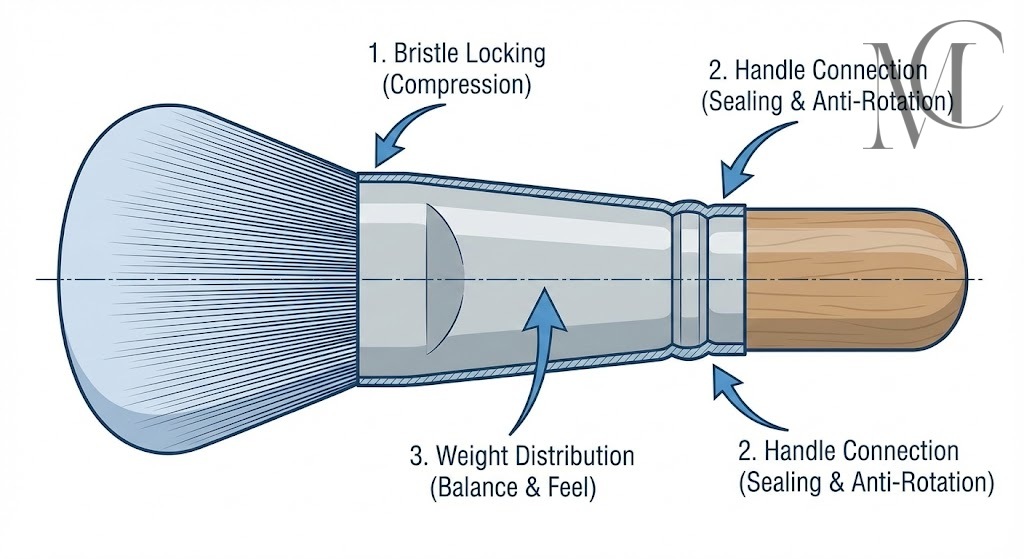
The makeup brush ferrule is the sleeve between the bristle bundle and the handle. Its responsibilities are mechanical and visual: contain and support the fibers, interface with the handle, provide a surface for crimping or bonding, and contribute to the finished brush balance and appearance.
A ferrule that looks flawless but does not properly fit the handle or secure the bristle assembly can still fail in use. Material selection is only one input in the complete makeup brush manufacturing process.
What Does the Ferrule Do?
Supports the Bristle Bundle
Proper bundle placement, adhesive distribution and ferrule formation help maintain brush-head geometry. Individual fiber shedding may also depend on fiber preparation and bonding quality.
Connects the Brush Head to the Handle
Ferrule-to-handle fit, surface preparation and the approved retention method affect whether the joint feels secure and resists rotation.
Influences Weight and Balance
Metal density, dimensions and handle material combine to create the overall brush feel. A heavier ferrule is not inherently more luxurious or ergonomic.
Provides the Visual Transition
Gloss, matte or plated finishes can reinforce a product identity. Ask for finish samples and acceptance criteria before artwork and packaging approval.
Aluminum Ferrules: Advantages and Trade-Offs
Aluminum is common in cosmetic brush construction because it allows lightweight designs and a range of decorative treatments. For a high-quantity collection, the lower weight may be helpful where shipping, daily handling and overall balance matter.
- Why brands consider it: lightweight feel, diverse finish possibilities and suitability for many brush formats.
- Engineering variables: specific alloy and temper, wall thickness, seam design if applicable, crimp location and tolerance.
- What to test: dents, edge quality, finish durability, joint retention and sample performance after cleaning.
Do not assume aluminum is always too soft for premium brushes. A well-specified aluminum ferrule can outperform a poorly designed heavier joint.
Brass Ferrules: Advantages and Trade-Offs
Brass may be selected for a more deliberate, weighted hand feel or certain ferrule geometries and decorative finishes. As with aluminum, the final result is shaped by wall thickness, forming processes, plating and adhesive compatibility.
- Why brands consider it: weighted balance, structural design options and specific decorative effects.
- Engineering variables: brass composition, mass, plating or protective coating, crimp behavior and cost.
- What to test: tarnish or coating changes, surface durability, component fit and joint retention.
Brass does not automatically guarantee superior corrosion resistance. A poorly coated brass component can discolor, and properly treated aluminum can perform well. Test the finished finish under your intended cleaning regime.
Common Makeup Brush Ferrule Failure Modes
When a brush fails, first distinguish the component, joint or coating involved. Changing from aluminum to brass may not solve a fault caused by adhesive application or dimensional mismatch.
| Observed issue | Possible causes | What the buyer should request |
|---|---|---|
| Ferrule loosens on the handle | Handle fit, surface preparation, adhesive cure or crimp design | Check dimensional fit, retention test method and bonding process |
| Brush head rotates | Joint geometry or adhesive integrity | Test torsional security of the finished assembly |
| Bristles shed | Bundle setting, adhesive penetration or fiber control—not only the metal | Evaluate bristle retention separately from handle/ferrule security |
| Surface discoloration or corrosion | Incomplete plating/coating, exposed material or unsuitable cleaning exposure | Inspect finish and review cleaning/chemical exposure tests |
| Dents or uneven edges | Wall thickness, forming quality, shipping protection | Check edge smoothness and dimensional tolerance |
| Water enters the joint | Assembly gaps, cleaning method and drying practices | Consider full-brush handling and wash tests |
How to Choose Aluminum vs Brass for an OEM Project
- Start with the makeup formula and brush function. Define the head size, density, handle length and target feel.
- Set a target weight and balance range. Evaluate assembled samples, ideally with the same bristle head and handle shape.
- Confirm dimensional requirements. Specify the ferrule profile, wall thickness, crimp locations and joint geometry.
- Confirm surface finish. Approve a master finish/color sample with realistic handling and cleaning expectations.
- Agree on inspection methods. Establish which assembly joints will be tested, by what method, on what sample count and to what acceptance criteria.
- Approve the full brush. Test application feel, storage and packaging protection before releasing bulk production.
If you are still selecting fibers or handles, compare the bristle, ferrule and handle material options and the custom handle design considerations before fixing a ferrule specification.
Ferrule Finish and Cleaning Performance
The corrosion response of a cosmetic brush ferrule depends on the completed surface. For example, a decorative plated surface may show damage at exposed edges, while an anodized or coated aluminum finish has its own abrasion and chemical sensitivities.
Check surface condition
Compare the approved gloss, matte texture, color and coating coverage before and after normal handling. Look for edge discoloration, scratches, blisters and visual inconsistency.
Check use conditions
Specify the intended brush-cleaning routine, exposure frequency, temperature and drying method. A harsh chemical soak is not a substitute for a realistic consumer or professional-use protocol.
Technical note: If the finish carries a claim such as recycled metal content or specialized corrosion performance, request evidence that applies to the actual supplied component and batch—not only a generic material data sheet.
How MECO Evaluates Ferrule Assembly
MECO's published OEM customization and production profile describes bristle preparation, handle fabrication, ferrule crimping, assembly and packaging within its current production scope. That profile also refers to a 16-step quality-control process, a 5 kg mechanical pull test associated with ferrule assembly and a 48-hour chemical soak test for adhesive durability.
5 kg Mechanical Pull Test: Confirm the Method
The published load is a useful discussion starting point, but the number alone does not establish the test configuration or the inspection coverage. An OEM buyer should clarify which interface is pulled (handle-to-ferrule, bristle-to-ferrule or another defined joint), load direction, fixture, load duration, sample count, pass/fail criteria and whether the sample was conditioned by washing or chemical exposure.
48-Hour Chemical Soak Test: Confirm Exposure Conditions
A duration without the chemical medium, concentration, temperature and post-test assessment cannot independently predict long-term durability. Ask what adhesive system, joint and finishing process are assessed and whether the selected exposure reflects your brush-cleaning requirements.
For the broader factory process, see MECO's quality-control information. Agree on project-specific sampling and acceptance conditions in writing before production.
MECO's published test descriptions are manufacturing reference information; this article does not assert that every brush undergoes each test, that independent certification covers each batch, or that the quoted values are universal industry standards.
Ferrule Sample Approval Checklist
Use the approved prototype as the practical reference for purchasing, production inspection and future repeat orders.
| Checkpoint | What to examine | Document or acceptance basis |
|---|---|---|
| Material and finish | Aluminum/brass type; approved appearance and coating | Approved drawing, finish standard, traceable component specification |
| Profile and wall | Ferrule geometry, wall thickness, symmetry and edge finish | Reference sample plus agreed dimensional tolerance |
| Assembly security | Crimp location, fit, adhesion and handle retention | Test configuration, sample size, acceptance criterion |
| Head and handle alignment | Angle, concentricity and visible gaps | Visual/dimensional comparison with signed-off sample |
| Cosmetic appearance | Plating or anodizing consistency, scratches and dents | Master color sample and inspection lighting |
| Wash/chemical response | Finish, adhesive and joint after agreed exposure | Media, concentration, duration and post-test criteria |
| Packed condition | No deformation, scratches or abrasion after transport | Approved inserts, protection, carton specification |
| Repeat production | Variation between sample and bulk batch | Pre-production sample and documented change approval |
Record any approved exceptions in the final purchase specification. A named metal and a product photo alone do not define an OEM production standard.
OEM Ferrule Specification and RFQ Worksheet
When requesting a factory quote, provide enough detail for an engineering review of the complete brush rather than quoting an isolated metal sleeve.
If you are making several brush styles, review custom brush performance and sample approval, and consider carton/inserts in the custom makeup brush packaging guide. The complete MECO OEM and private label customization process helps convert your design brief into sample requirements.
Related Makeup Brush Construction Guides
Useful next steps for OEM buyers:
How makeup brushes are madeMaterials selectionQuality-control frameworkCompare OEM suppliersFrequently Asked Questions About Makeup Brush Ferrules
What is the metal part of a makeup brush called?
The metal sleeve between the bristles and the handle is the ferrule. It helps secure the bristle bundle, connect the brush head to the handle, and determine the finished brush balance.
Is aluminum or brass better for makeup brush ferrules?
Neither is universally better. Aluminum is useful when low weight and decorative finishing flexibility matter; brass may suit an intentionally weighted feel or a more rigid construction. Compare the complete assembled samples at the same functional specification.
Does a brass ferrule always resist corrosion better?
No. Corrosion and tarnishing performance depend on alloy, plating or protective coating, surface preparation, exposure and cleaning conditions. Evaluate the finished ferrule surface rather than assuming one metal is always superior.
Can an aluminum ferrule be suitable for premium makeup brushes?
Yes. A properly specified aluminum ferrule with appropriate wall thickness, surface finish, adhesive and crimp geometry can be used for premium brushes. Premium quality depends on the finished brush rather than metal weight alone.
What causes a makeup brush ferrule to loosen or rotate?
Possible causes include poor dimensional fit, incorrect crimp location or pressure, unsuitable adhesive, inadequate bonding preparation, moisture exposure or production variation. Diagnose the joint and its materials before changing ferrule metal.
Does a 5 kg pull test guarantee that a brush will never shed?
No. A ferrule or assembly retention test checks a defined joint under specified conditions; it does not by itself demonstrate individual bristle retention, lifetime durability or performance after repeated washing. Confirm load direction, sample count, acceptance criteria and additional checks with the manufacturer.
What should OEM buyers approve before bulk ferrule production?
Approve a complete brush sample and written specification covering metal and finish, ferrule profile and wall thickness, handle and bristle fit, appearance, security checks, packaging protection and the permitted variation for repeat orders.
Can MECO customize ferrule color, size and construction?
MECO reviews ferrule materials, dimensional requirements and decorative finishes as part of an OEM brush specification. Feasible options, tooling, MOQ, schedule and inspection methods depend on the final brush design and should be confirmed before sampling.
Discuss Your Ferrule Specification With MECO
Send your target brush function, preferred ferrule material, handle specification, finish, estimated order quantity and intended cleaning requirements. MECO can review construction feasibility, sampling, MOQ and project-specific inspection needs before you approve the production sample.
Request an OEM Ferrule & Brush ReviewNote: Material and QC comparisons are sourcing guidance, not universal certification, testing or lifetime-performance guarantees. Final requirements must be confirmed for the purchased design.


